

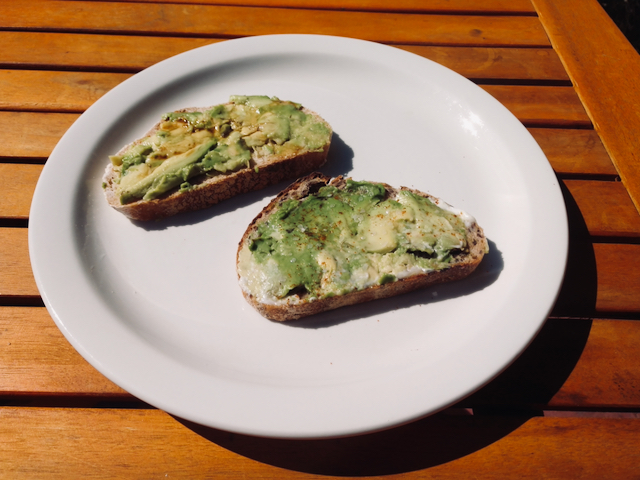
Avocados are tasty and one of our favorite health foods. If you are trying to increase your intake of healthy fats, especially on a vegan or vegetarian diet, the avocado is your friend.
And because it is a great addition to bread, aka Avocado Toast, I decided to write about it.
Wild Avocados in Mesoamerica
Avocados evolved in what is now Mexico and Central America. Earliest archaeological evidence is from 10,000 years ago, but avocados have been around for much longer, of course.
While green and not sweet, the avocado is a fruit, not a vegetable and dispersed like so many other fruits by animals. If you remember your biology class back in the day, seeds of fruit are dispersed by mammals and birds eating the fleshy part, including the seeds. After all passes through their digestive systems the seeds are deposited in a different place in a heap of fertile dung. Enter the avocado and its single large seed…
Are you picturing a similar, maybe painful process? I will leave this to everyone’s imagination, but be sure that I had some fun with this.
Seriously now, no birds or animals were harmed in propagating the wild avocado. It is believed that avocados are part of the giant flora that co-evolved with giant fauna that had giant mouths and digestive systems, for example the giant ground sloths (picture a rodent as large as or larger than a modern minivan). For these immense animals, an avocado sized seed was no problem, they were able to swallow the entire avocado and seed and move on to other giant flora. A few days later the seeds would be deposited in new and dispersed places ensuring the survival of the avocado trees. After giant fauna such as the ground sloths disappeared from the Americas about 13,000 years ago, avocados didn’t have an efficient partner to help with propagation until humans domesticated the avocado over 5,000 years ago. The avocado is save thanks to cultivation rather than digestion.
Avocado, A Very Local Fruit
Human use and spread happened slowly. Avocados were a staple food of the ancient Maya and Aztecs. The Spaniards encountered avocados in Central and South America in the 16th century and started to introduce them around the world. But the avocado, like other exotic foods, had a slow start around the world.
In the US, the avocado was introduced in Florida, Hawaii and California in the first half of the 19th century. Some of the first avocado trees were planted in Santa Barbara in 1871 by Judge R. B. Ord and the first plantation of 120 trees was in Montecito in 1895. The modern story of the avocado starts very much in our backyard, Santa Barbara. From here, avocados were planted more widely in Southern California. The fruit received its current name (earlier names were ahuacate and alligator pear) in 1915, growers developed new varieties, and by the 1920’s started shipping to Chicago, New York and Europe. Still, the current ubiquity of the avocado in all types of foods didn’t happen until the 1990s and since the 2000s the avocado has conquered the world.
For everyone who has grown up and lived in Southern California in the later part of the 20th century, avocados may feel as nothing special, but for the rest of the world, it is still a relatively new discovery and love.
Buying My First Avocado
As a teenager in the 1990s in Germany, I knew about avocados. We ate them at home for dinner as part of a Caprese Salad, the Italian layered appetizer with tomatoes, fresh mozzarella and basil. We added avocados and I thought of the avocado as a very Italian ingredient.
One day in summer, my mother asked me to get some produce from a local farmer in a nearby village. So I jumped on my bike and got lettuce and avocado (not grown locally, of course). There were two avocados, no more, no less. One was green, that looked just right to me, and one black and shriveled, that to my untrained eye looked way past its prime. I watched with dismay as the woman serving me picked the black avocado telling me: “Ah, just perfect for your dinner tonight.” I swallowed, but didn’t know what to say. Instead of requesting the green one instead or questioning her choice, I silently packed my produce including this appalling avocado, paid and pedaled back home. My mother unpacked the groceries and to my surprise, was delighted with the avocado.
I had learned something. Not just that Hass avocados are black when ripe, but that it is sometimes good to be quiet despite your own uninformed convictions.